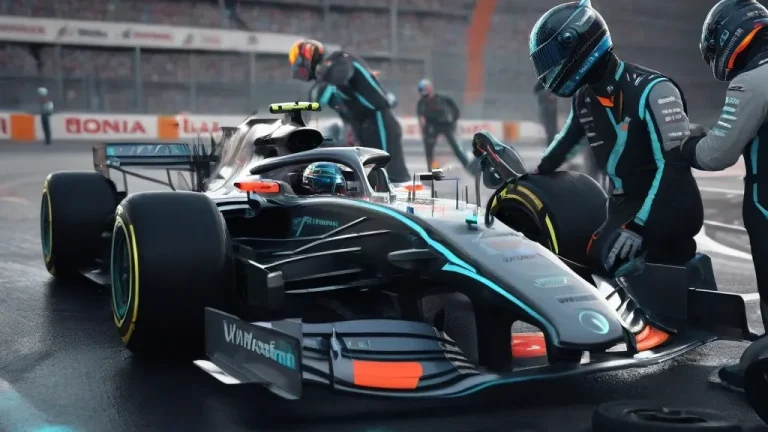
Imagine a tense Formula 1 race, the crowd roaring as two drivers battle neck and neck in the final laps. Victory hangs in the balance, seemingly determined by who dares to brake latest into the next corner. But what if the real battle was being fought miles away, on the pit wall, where a team of engineers and strategists are dissecting mountains of data, predicting tire degradation, and calculating the optimal moment to pit? The call comes, a lightning-fast decision altering the course of the race, catapulting one driver to victory while leaving the other to wonder ‘what if?’
F1 isn’t just about raw speed; it’s a high-stakes strategic chess match played at breakneck speeds. Winning races hinges on split-second decisions made on the pit wall, blending sophisticated data analysis with human intuition honed over years of experience. This is where race strategy meets reality, combining real-time information, predictive models, and the courage to make bold calls in the face of immense pressure. It’s more than mere guesswork; it’s a science, an art, and the key that helps F1 drivers and teams to win races on the track.
The Foundations: Data, Simulations, and Preparation
Effective Formula 1 strategy isn’t born on the pit wall during the race. It’s meticulously crafted in the weeks and months beforehand, built on a foundation of relentless data analysis and sophisticated simulations. Imagine a whirlwind of information – tyre wear from previous races, fuel consumption figures meticulously logged, historical weather patterns for the circuit, and even the minute-by-minute performance of rival cars. This deluge of data forms the bedrock upon which race strategies are built.
Teams then unleash the power of Monte Carlo simulations, running thousands upon thousands of race scenarios. Each simulation tweaks variables like pit stop timing, tyre compound choices, and even the likelihood of safety cars. The goal? To create not just a single strategy, but a robust, adaptable plan that can withstand the unpredictable nature of a Grand Prix. This pre-race preparation identifies the optimal strategy; however, the live telemetry ultimately dictates the final call. It’s about maximizing opportunities and minimizing risks based on real-time information.
Understanding Tyre Compounds
The black circles of Pirelli rubber are more than just what the car sits on; they’re a crucial piece of the F1 strategic puzzle. Each race weekend brings a selection of tyre compounds – typically soft, medium, and hard – each possessing a unique blend of grip and durability. Soft tyres offer blistering pace but degrade quickly, meaning more grip but shorter stints. Hard tyres provide longevity but lack the outright speed, so less grip but longer lasting. Medium tyres sit in the middle, as the name suggests, offering an appropriate balance.
Understanding these characteristics is paramount. During practice sessions, engineers analyze mountains of tyre data to predict performance and pinpoint degradation rates. Factors like track temperature, driving style, and even the car’s setup significantly influence how each compound behaves. Teams are looking for the optimal pit stop window – the point at which switching to a fresh set of tyres provides the greatest advantage without sacrificing track position. Tyre management is therefore a high stake in F1 strategy.
The Power of the Undercut and Overcut
In the high-stakes world of Formula 1, races are often won and lost not on raw speed alone, but on the razor’s edge of strategic decisions. Two of the most fundamental, yet potent, strategic tools in an F1 team’s arsenal are the undercut and the overcut. These maneuvers, executed during pit stops, can dramatically alter a running order and swing the momentum of a race.
The undercut is a strategy where a driver pits earlier than their rival in an attempt to gain track position. The logic is simple: fresh tires provide a significant performance advantage, allowing the driver completing the pit stop to set a series of quick laps. If those laps are fast enough, the driver can emerge ahead of their rival after the rival makes their own stop later on. It’s a gamble, betting short-term pain for long-term gain.
Conversely, the overcut involves staying out on track longer than a competitor, extending the current stint, and then pitting later. This relies on the assumption that the older tires will hold up sufficiently to maintain a competitive pace, and that the later pit stop, combined with the fresh-tire advantage in the subsequent laps, will allow the driver to jump ahead. The overcut often hinges on managing tire degradation effectively and capitalizing on any unexpected events, such as a safety car, towards the end of the stint.
Decoding the Data Stream: Real-Time Analysis
During any race, success hinges on the ability to decipher the constant flow of information. Teams are ingesting live telemetry data, turning raw numbers into a clear understanding of the current situation. From tyre pressures and engine performance to minute changes in driver behavior and the pace of competitors, every piece of data is scrutinized. This relentless monitoring isn’t just about observing; it’s about anticipating what’s next. Sophisticated predictive modelling comes into play, forecasting potential race scenarios based on the current data. These models simulate different outcomes, allowing teams to proactively adjust their strategy. Having access to real-time data also enables a team to quickly adapt their live strategy.
In one particular race, we noticed, through real-time tyre data, that our driver was beginning to struggle with grip far earlier than anticipated. Based on this, we made the call to bring him in for a tyre change sooner than planned. This decision, driven by real-time analysis, allowed us to jump ahead of a competitor who stayed out longer and ultimately lost valuable positions.”
Using Weather Forecasts
Weather is also a major factor to impact perfomance. Track temperature, moisture levels, and wind speed are constantly monitored because even a small change can drastically alter tyre grip and overall car handling. Teams are adept at switching between tyre compounds, modifying aerodynamic settings or adapting engine mappings in response to track conditions. The transition from dry to wet also presents a unique set of challenges, requiring drivers to adjust his driving style and engineers to optimize car balance for the treacherous and slippery conditions.
A sudden downpour caught our team completely off guard, transforming a comfortable lead into a desperate fight for survival. As the track became increasingly slippery, the driver struggled to keep the car on the track. This unforeseen weather event shuffled the order and turned what seemed like a sure victory into a disappointing finish.
The Human Element: Communication and Split-Second Decisions
Behind every successful Formula 1 team lies a powerful triangle of trust: the strategist, the race engineer, and the driver. While sophisticated data analysis forms the bedrock of race strategy, it’s the human element – instinct, experience, and, crucially, clear communication – that transforms raw data into winning decisions made in the blink of an eye.
The race engineer serves as the crucial link, filtering the torrent of telemetry and relaying vital information to the driver. But it’s not a one-way street. Driver feedback, nuanced and often delivered under immense pressure, is immediately used to refine the car’s setup, adjust the strategy, and respond to the ever-changing track conditions. It requires a deep understanding between the driver and engineer, a shared ‘language’ developed over countless hours of testing and racing.
The strategist, armed with real-time data and competitor analysis, formulates the overall race plan. However, the best-laid plans can be instantly upended by unexpected events – a sudden downpour, a safety car, or a rival’s aggressive maneuver. These are the moments when split-second decision-making becomes paramount. A calm, decisive strategist, communicating effectively with the race engineer and trusting the driver’s assessment of the situation, can turn a potential disaster into a strategic masterstroke.
The connection between the driver and strategist is especially important. The driver is the strategist’s eyes and ears on the track, providing invaluable insights into tire degradation, grip levels, and the behavior of other cars. This allows the strategist to refine the plan based on real-time feedback. It’s a high-stakes game of chess played at 200 mph, where clear communication and mutual trust are essential to achieving victory.
Safety Car Scenarios
Safety Car (SC) deployments are pivotal moments in any race, instantly injecting an element of unpredictability. Teams face a high-pressure decision framework, needing to rapidly analyze the situation and make critical calls that can dramatically alter the race outcome. The initial assessment involves identifying whether it’s a full Safety Car or a Virtual Safety Car (VSC), as this impacts the potential time savings and strategic options available.
A crucial consideration is the potential pit stop window created by the SC. Teams evaluate whether pitting now would allow them to gain track position by effectively getting a “free” pit stop, losing less time than they would under normal racing conditions. However, this decision isn’t without risk. A poorly executed pit stop or a slow release back onto the track could negate any potential gains. Furthermore, pitting drops the driver down the order, requiring them to overtake other cars to regain their original position. The risk assessment involves weighing the potential time savings against the risk of losing track position and the difficulty of overtaking.
The decision to pit or not to pit is also heavily influenced by track position. If a driver is leading or in a strong position, the team might opt to stay out, prioritizing track position and control of the race. Conversely, if a driver is further down the order, a gamble on a pit stop might be seen as a worthwhile risk to gain an advantage. The restart strategy is another critical element. Teams analyze tire conditions, fuel levels, and the positions of their competitors to optimize their strategy for the race restart. Successfully exploiting Safety Car periods requires a combination of quick thinking, precise execution, and a willingness to take calculated risks.
Common Pitfalls and How to Avoid Them
Strategic errors in any competitive field, especially those demanding quick thinking and precision, can be extraordinarily costly. To navigate the complexities of competition effectively, teams must proactively learn from past mistakes and implement strategies that significantly mitigate risks.
Over-Aggressive Strategy
One common pitfall is adopting an overly aggressive approach without adequately considering all variables. For example, miscalculating tyre degradation due to an underestimation of track temperature can lead to unscheduled pit stops and a significant loss of position. This can be avoided through thorough pre-event simulations and real-time data analysis to fine-tune strategy based on actual conditions.
Missed Opportunities
Reacting too slowly to changing conditions presents another significant challenge. Spotting a change in weather patterns and failing to capitalize on the strategic advantage it offers can turn a potential win into a mid-field finish. Teams should foster an environment encouraging rapid communication and decision-making, enabling them to adapt swiftly to any scenario.
Data Bias
Data bias also presents a lurking risk. Relying too heavily on specific data sets while ignoring broader trends can skew decision-making. Teams should ensure that their data analysis incorporates diverse sources and perspectives to provide a comprehensive view, which is essential for robust strategy formulation.
Lack of Preparation
A lack of comprehensive preparation is perhaps the most fundamental pitfall. Teams need to invest time in simulating various race scenarios, anticipating potential challenges to train responses. Proactive preparation reduces the likelihood of being caught off guard and ensures that the team is ready to address whatever the competition throws their way.
The Future of F1 Strategy
The high-octane world of Formula 1 is on the cusp of a strategic revolution. Emerging technologies are set to redefine how teams approach racing, moving beyond traditional methods to embrace a data-driven future. Artificial intelligence and machine learning algorithms are poised to analyze vast datasets, predicting optimal race strategies with unparalleled accuracy. Advanced data visualization tools will provide strategists with real-time insights, enabling quicker, more informed decisions in the heat of the moment.
Imagine a future where strategy automation minimizes human error, and predictive analytics anticipate competitor moves with astonishing precision. This isn’t science fiction; it’s the next chapter in the evolution of motorsport, where every race is a chess match played at 200 mph, powered by the relentless pursuit of data-driven dominance.
Conclusion
In the high-octane world of Formula 1, a well-executed strategy isn’t merely a supporting element; it’s the very engine driving performance. Modern F1 demands a symphony of elements, with data at the forefront, guiding the orchestra. Teams that fully embrace data-driven insights, cultivate transparent communication channels, and demonstrate nerves of steel when making pivotal decisions under immense pressure are the ones that consistently unlock their true potential and clinch victory. This strategic prowess is what separates the contenders from the champions.
So, whether you’re a seasoned motorsport enthusiast or a curious newcomer, consider how these strategic elements shape every race. By applying these insights, it can greatly improve your understanding and appreciation of this exhilarating sport!